El Jem amphitheater
|
Situation: Center Horary:
From 16/09 to 31/03: 08.30 - 17.00 From 01/05 to 15/09: 07.30 - 19.00 Visit cost: 20 Dinars |
The gladiator fights is possible without using the magic of cinema. Just over an hour from Sousse, the greatness of the Roman Empire awaits us.
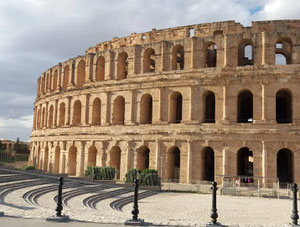
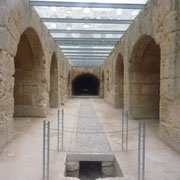
In the small town of El Jem stand the impressive ruins of the most famous Roman colosseum in North Africa and one of the best-preserved in the world. The ancient city, called Thysdrus, was founded by the Phoenicians. This 3rd-century construction showcases the greatness and vast reach of the Roman Empire: almost elliptical in shape, the monument measures 149 metres in length, 124 metres in width and 36 metres in height. The stands, partially rebuilt, could hold up to 30,000 spectators, placing the El Jem amphitheatre in fourth position after those of Rome, Capua and Pozzuoli. The arena, 65 metres long on its major axis, is crossed in its underground level by two large galleries through which gladiators and wild animals entered (and which can be visited thanks to their easy access).
The material used for its construction was sandstone from the Mahdia region, a resistant and easy-to-carve stone.
In the colosseum, one could watch violent spectacles similar to those shown in films. Condemned prisoners had here a chance to save their lives if they managed to survive the games. Before your trip, we recommend watching one of these films, such as Gladiator, to experience your visit with greater intensity.
Symphonic music festival in El Jem
Every summer, the impressive El Jem amphitheatre becomes a unique stage for the International Symphonic Music Festival. Under the stars and surrounded by Roman history, renowned orchestras fill one of the Mediterranean’s most remarkable monuments with acoustic magic. An unforgettable cultural event that blends art, heritage, and emotion.

For a long time it had no other role than that of a historical monument but in the last two decades the El Jem coliseum has served to host the symphonic music festival in summer as well as other
artistic events.
World Heritage by UNESCO in 1979.



What to see near El Jem