The archaeological city of Carthage
|
Situation: Tunis Horary:
From 16/09 to 31/03: 08.30 - 17.00 From 01/05 to 15/09: 07.30 - 19.00 Visit cost: 20 Dinars |
Who does not remember the feat of Hannibal crossing the Alps with an army of elephants? It happened during the Punic wars, the fierce struggle between Rome and Carthage for hegemony in the Mediterranean. The remains of the city that had the audacity to challenge the Roman Empire are in Tunisia.
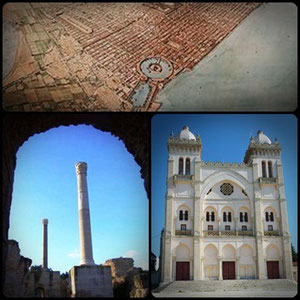
Carthage was founded in the 9th century B.C. on the Gulf of Tunis. From the 6th century onwards, it developed into a great trading empire covering much of the Mediterranean and was home to a brilliant civilization.
In the course of the long Punic wars, Carthage occupied territories belonging to Rome, which finally destroyed its rival in 146 B.C. A second – Roman – Carthage was then established on the ruins of the first.
Legend has it that coming from Tyr in Phoenicia, princess Elyssa (Dido) founded the “New City” (Carth Hadasht, in Phoenician) in 814 BC. As time passed it became the
powerful capital of a maritime empire stretching over the whole western Mediterranean basin, before seeing Rome, its rival and enemy, compete with it, supplant it and then defeat it, taking it
and destroying it in 146 BC.
Once part of the Roman empire, Carthage was rebuilt under Octavian Augustus at the end of the lst century BC and endowed with the attributes of a large Roman city :
urban infrastructure, public secular and religious buildings, sumptuous houses.
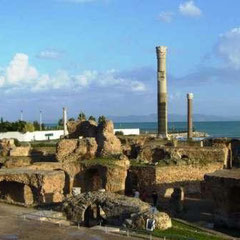
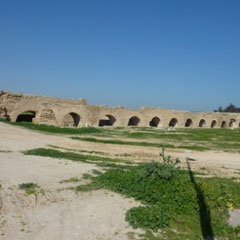
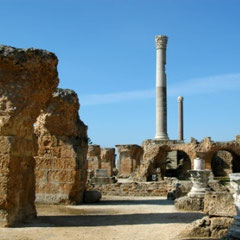
The Antonine Baths is the richest and most imposing complex of
the archaeological site of Carthage. It consists of the baths themselves, located on the shore, not far from the ancient port installations, and in the opposite direction, of gardens enclosing
vestiges dating to different periods of Antiquity.
World Heritage by UNESCO in 1979.
Elisa of Tyre, the founder of Carthage
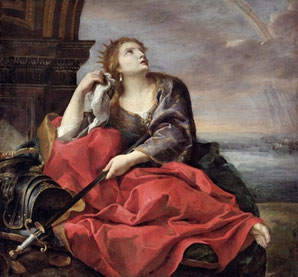
Elissa, princess of Tyre, is a legendary figure of antiquity. According to tradition, she fled Tyre after the murder of her husband Sychaeus by her brother Pygmalion, the king.
Accompanied by her loyal followers, she crossed the Mediterranean and founded Carthage in the 9th century BC.
Elissa, known as Dido to the Romans, is celebrated as a wise and courageous queen with remarkable political acumen. Her story—marked by exile, foundation, and a tragic fate—has become one of the great myths of the Phoenician and Roman worlds.
What to see near Carthage
Hotel de charme

Dar Amilcar
Rue Slaheddine Bouchoucha 110
Luxurious guesthouse located between Carthage and Sidi Bou Said.